Learning Outcomes:
i. Define osmotic adjustment and explain its significance in plant physiology.
ii. Describe the concept of water potential and its role in osmotic adjustment.
iii. Explain how plants accumulate solutes to maintain cell turgor and water balance in varying environmental conditions.
iv. Discuss the types of solutes involved in osmotic adjustment and their contributions to plant stress tolerance.
v. Analyze the adaptive significance of osmotic adjustment in different plant species and environments.
i. Osmotic Adjustment: Maintaining Balance in a Changing World
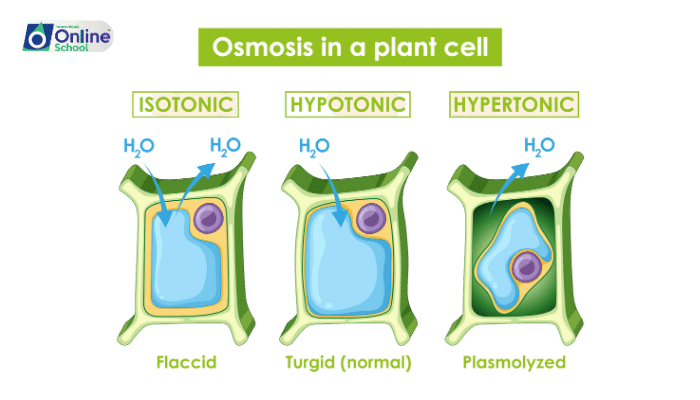
Plants, like all living organisms, depend on water for their survival and growth. However, they often face challenges in maintaining their water balance due to fluctuating environmental conditions, such as drought, salinity, and temperature extremes. Osmotic adjustment is a crucial physiological mechanism that allows plants to adapt to these challenges and maintain cell turgor, the pressure exerted by the cell contents against the cell wall.
ii. Water Potential: The Driving Force of Water Movement
Water potential is a measure of the chemical potential of water relative to pure water. It is a combination of three components: solute potential, pressure potential, and matric potential.
Solute potential (Ψs): Solute potential decreases as the concentration of dissolved solutes increases. The presence of solutes lowers the water potential of a solution compared to pure water.
Pressure potential (Ψp): Pressure potential increases with positive pressure. Positive pressure increases water potential, while negative pressure decreases it.
Matric potential (Ψm): Matric potential is typically negative and arises from the attraction between water molecules and the surfaces of surrounding materials, such as cell walls and soil particles.
iii. Maintaining Cell Turgor through Solute Accumulation
Cell turgor is essential for maintaining cell shape and supporting various cellular processes. Under conditions of water stress, such as drought or high salinity, the water potential of the surrounding environment decreases. To maintain cell turgor, plants actively accumulate solutes inside their cells, increasing their solute potential and bringing it closer to the water potential of the environment. This process is called osmotic adjustment.
iv. Types of Solutes Involved in Osmotic Adjustment
Plants accumulate various types of solutes for osmotic adjustment, including:
Organic solutes: These include sugars, amino acids, and organic acids. Organic solutes are often accumulated in large amounts and can contribute significantly to osmotic adjustment.
Inorganic ions: These include potassium (K+), sodium (Na+), chloride (Cl-), and other mineral ions. Inorganic ions play a role in osmotic adjustment and also contribute to various cellular processes.
v. Adaptive Significance of Osmotic Adjustment
Osmotic adjustment has significant adaptive value for plants growing in diverse environments:
Drought tolerance: Osmotic adjustment allows plants to maintain cell turgor and continue to function under drought conditions, protecting them from water stress and desiccation.
Salinity tolerance: Osmotic adjustment enables plants to tolerate high salinity in the soil by counteracting the effects of high solute concentration and maintaining cell hydration.
Temperature tolerance: Osmotic adjustment can help plants cope with temperature extremes, such as freezing or heat stress, by stabilizing cell membranes and protecting cellular processes.
Osmotic adjustment is a remarkable adaptive mechanism that allows plants to maintain cell turgor and water balance in a wide range of environmental conditions. By accumulating solutes, plants can regulate their water potential and protect themselves from water stress, salinity, and temperature extremes. Understanding osmotic adjustment provides valuable insights into plant physiology, ecology, and agriculture.
